 |
|
|
While the defense priorities of World War II took toy trains off the market, it didn't stop toy train development at either of the two leading producers at that time, American Flyer and Lionel. The production pause gave both companies time to plan big changes in their products for the post-war period to come. At American Flyer, it was an intensive continuation of the innovations that had been in place ever since the company had been acquired by Gilbert in 1937. Gilbert had a passion for scale modeling and began turning his new acquisition in that direction almost immediately with the introduction in 1938 of the "Tru-Model" HO scale trains. I believe that HO was really his first love as he was planning to introduce them even before the acquisition of American Flyer. Recognizing the need for larger size trains for children to play with, a decision was made in late 1938 to create a line of scale "Tru-Model" O gauge trains scaled at 3/16 inch to the foot but still running on O gauge track. This was not to be the end point in the development of the Tru-Model trains. As early as December of 1938, it was decided to move the O gauge line to 2 rail 7/8 gauge track, which more accurately represented prototype standard gauge at 4 feet 8 1/2 inches.
Aside from the considerable effort being expended on moving from O gauge to what would become S gauge (S was not designated as a gauge by the NMRA until 1943) Gilbert, along with Lionel, was also working on other innovations, one of which was smoke. Gilbert had already brought out a choo choo device in their pre war line, but what was missing was smoke. It is believed that Gilbert had made this a goal as early as 1939. Throughout the war years Gilbert engineers worked on the best way to do this. The 1944 Catalog promoting things to come after the war, even let the cat out of the bag a bit by showing a smoking locomotive with the words choo choo next to it. American Flyer and Lionel both knew that they were not alone in their quest for a smoking locomotive and the race was on.
A few weeks before the toy fair of 1946, Gilbert got indications that Lionel would be demonstrating a smoking locomotive. Gilbert wanted to beat them and the race intensified. The only problem was that the locomotives in development were in the new S gauge and there wasn't an appropriate place to demonstrate them. They had a fine layout in the 5th Avenue window of Gilbert Hall of Science in New York City, but it was 3 rail O gauge, even though it had been re-done during the war years. This required a massive track laying effort which took place on Saturday, March 2nd, 1946. Fortunately, the new S gauge track shared its radius of approximately 20 inches with the old O gauge line so it was a section for section replacement.
In an article in the Train Collectors Quarterly, Bruce Manson recounts what he saw during his visit to the New York Hall of Science that Saturday:
| I walked by the Hall of Science and saw the track was being changed in the window from "O" to a new type of two-rail track. I remember they were meticulously installing plaster molds with wooden ties embedded between the metal ties (this, of course, was before rubber roadbed). I remember speaking to one of the salesmen and he said, “come back this afternoon and you will see something in toy trains you have never seen before”. That afternoon, I witnessed the first "smokers" to come from New Haven. Quite a sight, especially when two or three were parked on a siding and allowed to smoke. |
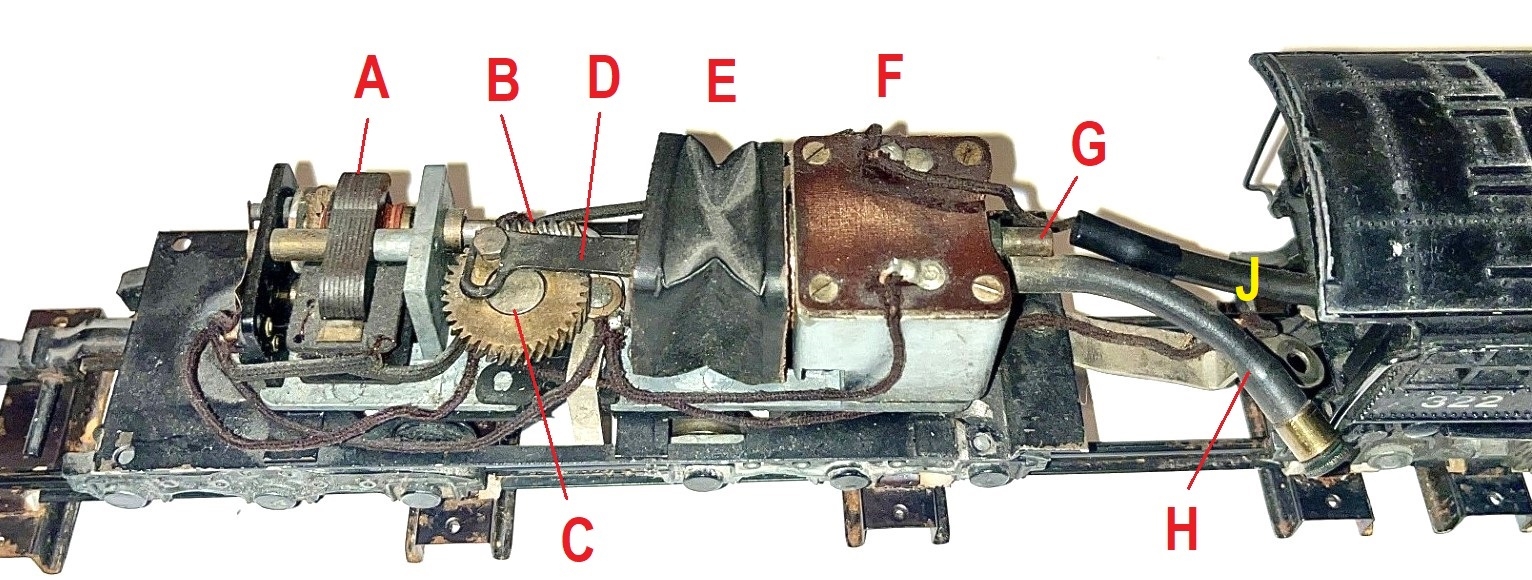
Open-frame motor (A) and worm (B) turned worm gear (C). Eccentric (D) operated
bellows (E). which forced puffs of air into smoke chamber (F), which contained
fiberglass to absorb smoke fluid and resistance wire to heat it. “Smoke” was
piped from (G) through hose (J) to stack at front of locomotive. Smoke fluid was
replenished by squirting it through tube (H).
Photo courtesy Gary
Baloun - Annnotations by Joseph Lechner
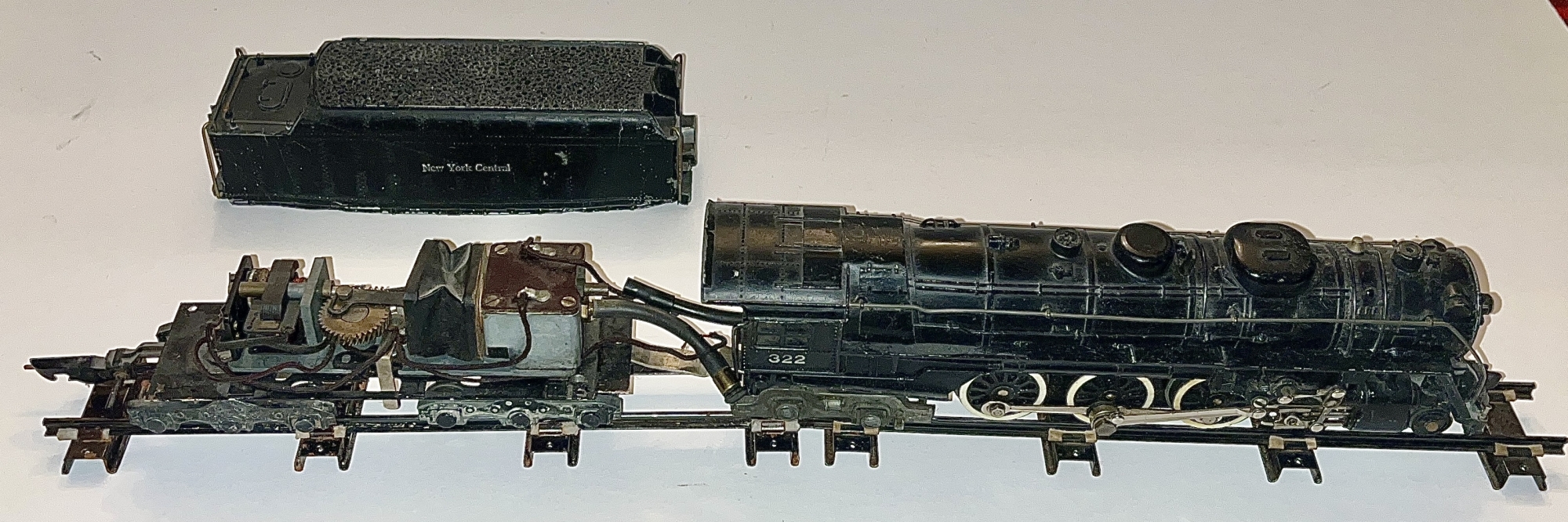
Gabe Monaco, one of Gilbert's development engineers, had been charged with making sure everything went as planned and fortunately it did. Gabe's engineering sample locomotives developed for this show were a bit different from what eventually became production locos. Instead of the fill cap jutting through the coal pile that we see on most smoke in tender units, these had the fill tube at the front of the unit. It had to be swung out, held up, and uncapped to insert the fluid. We are extremely lucky that the very first locomotive to demonstrate Gilbert's smoke feature still exists today. Its current custodian is Gary Baloun who generously shared photos of it for this website.
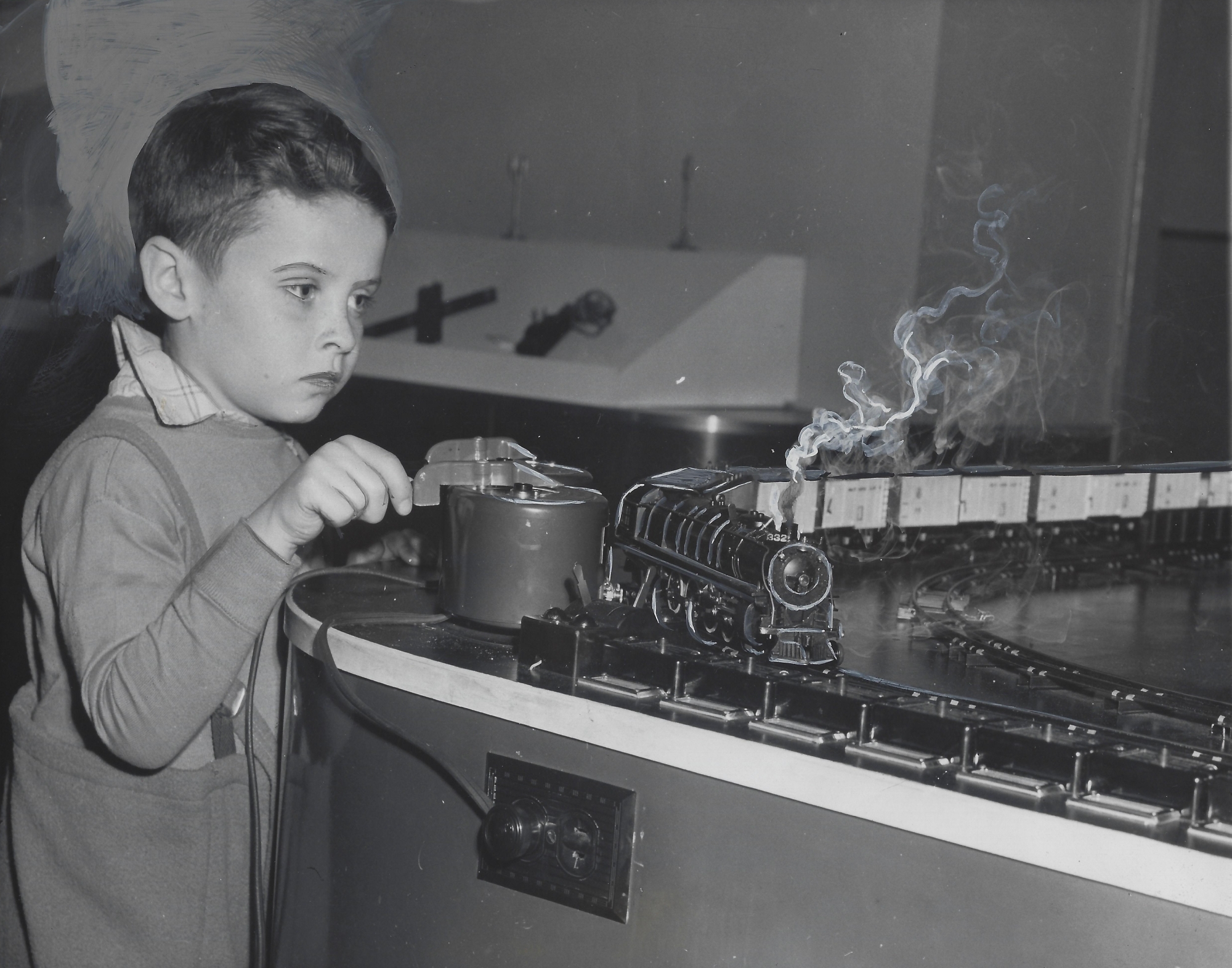 When
the Toy Fair was held later in March of 1946 Gilbert was there with
their smoking locomotives. The Associated Press photo at the
left show a young man identified as Jimmy Dillon at the controls of
a Gilbert 4-8-4 Northern, which by that time had been made available
in S Gauge with a smoke in tender smoke unit. The 4-8-4
Northern, as well as the 0-8-0 Switcher. were not released in
production models in 1946. The only 1946 units that exist were
a limited number of engineering samples. When
the Toy Fair was held later in March of 1946 Gilbert was there with
their smoking locomotives. The Associated Press photo at the
left show a young man identified as Jimmy Dillon at the controls of
a Gilbert 4-8-4 Northern, which by that time had been made available
in S Gauge with a smoke in tender smoke unit. The 4-8-4
Northern, as well as the 0-8-0 Switcher. were not released in
production models in 1946. The only 1946 units that exist were
a limited number of engineering samples.Photo Courtesy of Gary Baloun |
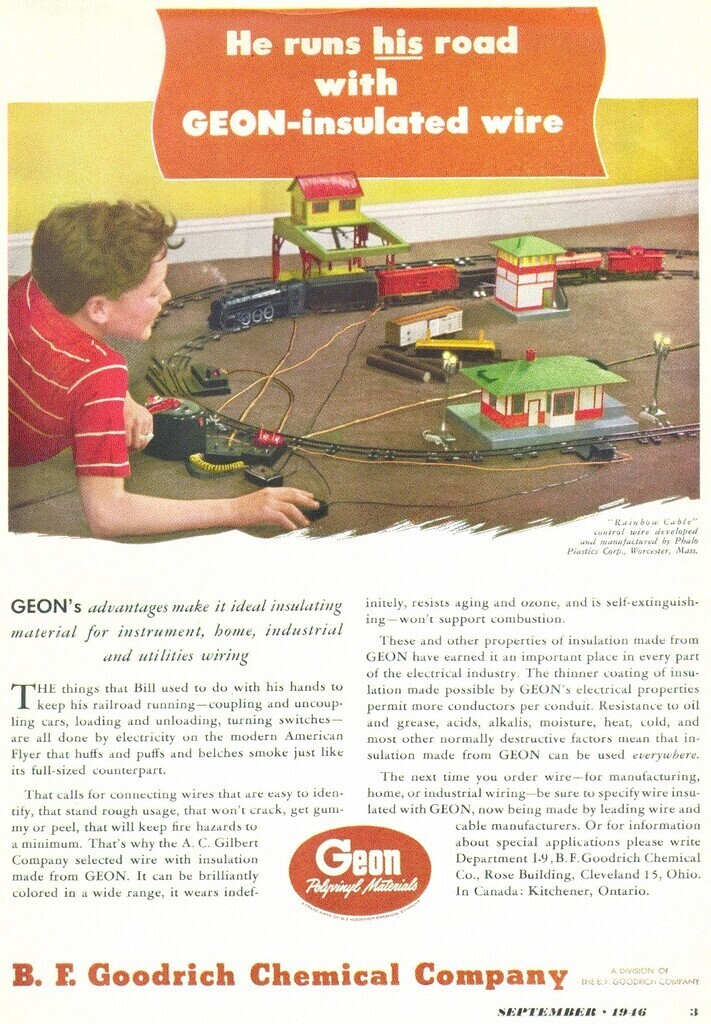 This original locomotive went on to star in this B.F. Goodrich ad promoting Geon insulated wire. Phalo Plastics produced the wire that used B.F. Goodrich Geon polyvinyl chloride. The Gilbert connection was that Phalo's Geon insulated wire was used by Gilbert for the rainbow wire on the switches and also offered separately. In the immediate post-war period, toy trains were so popular that product tie ins, such as this one, were frequently used. Since most train enthusiasts tend to hide their wire, it is noteworthy that this photo features the wire front and center, for obvious reasons. Some Gilbert historians have speculated that the boy in the photo may be Robin Monaco, the son of Gabe Monaco, a major developer of the Gilbert smoke unit. He was born in 1940 and in 1946 would be the right age for the boy in the photo. The original transparency that was used for this ad can be seen in a slideshow including other original color shots used in advertising. The last three images in that slideshow are of that transparency and this ad. Click here to view that slide show. Photo from Modern Plastics, September 1946 (Click on image to view ad full size)
|
Changes to the Gilbert smoke generation system were made over the years. Even before the production locomotives were released the fill tube was moved to the top of the unit. While this fluid type of smoke generation system eventually won out over all others, it was just a beginning step. From the patents on file, we can see that, even from the beginning, this was not what Gilbert envisioned as the end product. Gilbert produced smoke in tender units from 1946 to 1947 in S Gauge and actually used the same unit, with minor variations, in HO gauge from 1947 to 1949. These were succeeded in both lines by the familiar smoke in boiler mechanism that served Gilbert well until its end in 1967.
Looking at this early smoke in tender design objectively, it is complicated and must have been costly to produce with an additional motor and drive mechanism. If for no other reason than this, further refinement was a commercial necessity. In addition, while its smoke output and choo choo sound varied with the speed of the locomotive, it wasn't as well synchronized with the motion of the engine as the smoke in boiler units. This was simply because it was driven by a different motor with a different speed to voltage curve. One thing that still delights American Flyer collectors and operators to this day is that the smoke in tender units could puff smoke while sitting on a siding in neutral. This was something that the smoke in boiler units couldn't do since they ran off the same motor that propelled the train.