 |
|
|
This
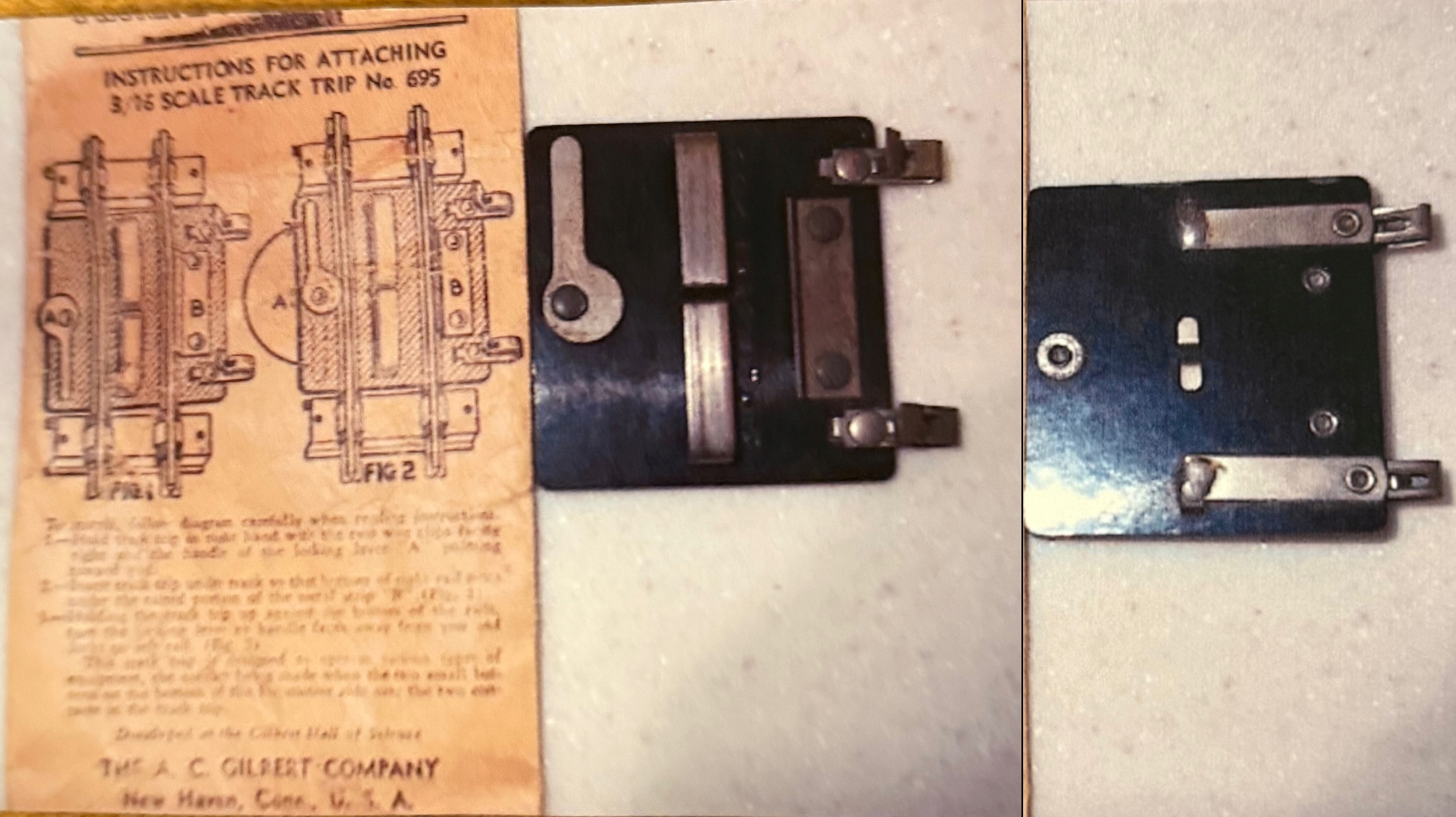
is a very rare item from 1946 and I only know of two in existence in
the hands of two different collectors. It is so rare that many
have believed that although it was cataloged, it was never made.
Obviously that is incorrect. Both known examples came
from the Estate of E. Z. Schwafel, who operated a toy & hobby shop
in Sunnyvale, California.
It was intended to operate the 587 target signal and 588 semaphore.
Only the 587 was available and all of those were produced before
World War II. This is the reason you find brass spring loaded
buttons on the bottom of the chassis of most 1946 locomotives.
Those brass buttons contacted the spring loaded strips on the trip
joining them electrically during the time when the two buttons on
the locomotive were each on a different strip. In order to
operate the signal you needed two track trips. One just before
the signalized section to turn the signal red for the oncoming train and kill power
to a controlled section of track at the front of the signal, and one just after the
signalized section to turn the signal green again and restore power
for the train at the signal.
Technically this should have worked as the chassis was electrically
isolated from the rails. (Some models beginning in the late
50's had a "hot" chassis, but that wasn't a concern in 1946 models.)
As you can imagine, the period of time when one button was on one
strip and the other on the other strip was very short and would get
even shorter if the train speed was increased. The main factor,
though,
was that Gilbert was using very shallow flanges on the locomotives
and cars in 1946 and they tended to derail. Adding to
the likelihood of derailment was the very light unweighted plastic
bodies of the early post war cars.